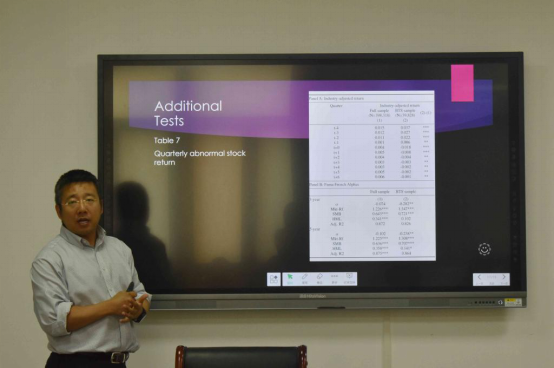
On the afternoon of July 16, 2019, Professor Gao Lei from the Finance Department of the Business School of Iowa State University was invited by our school to give an academic report entitled "Leverage-constrained investors, asset prices and corporate financing decisions" at Y309, Yifu Building, Yanshan Campus . The lecture was presided over by Dean Sun Wengang, and some teachers from the School of Accounting and some postgraduate students of the 2018 grade listened to the lecture. Professor Gao Lei is mainly engaged in research on financial markets, asset return forecasting, empirical corporate finance, corporate supervision, corporate culture, text analysis and machine learning, and will serve on the US Securities Regulatory Commission in September 2019.
First, Professor Gao introduced the research background of "investors, asset prices and corporate financing decisions subject to leverage". He pointed out that in order to obtain high returns, some investors subject to leverage will tend to take risks, that is, choose high beta stocks, which will lead to overvaluation of these stocks. Eventually, the market feedback mechanism can be observed, that is, whether companies will Use this investment behavior to make new financing decisions.
Then, Professor Gao elaborated the research theory. He believes that investors ideally deviate from the market price and will invest in higher-risk assets; the market safety line is better than the asset pricing theory predicts; the flatter securities market line means the wrong valuation (overvalued High-beta stocks and undervalued low-beta stocks). Then, Professor Gao pointed out that the research contribution of this article has three points. First, more and more people have begun to reexamine the impact of leveraged investors on asset prices in the asset pricing literature, but few people associate it with corporate finance. The second is to study the impact of investors’ leverage constraints on asset pricing and corporate financing decisions, so that companies can make further investment and operating decisions based on market share price performance. Third, in the corporate financing literature, the existing research evidence cannot determine whether invalid mispricing will affect corporate financing behavior, but this article provides an empirical test for this.
Finally, Professor Gao put forward a key hypothesis: Since investors subject to leverage will chase high beta companies, these companies will tend to own more capital, especially if they choose to issue more stocks. In order to verify this key hypothesis, Professor Gao obtained insider trading data from the Thomson Financial Corporation database, SEO and M&A information from the SDC database, and used the period 1990-2016 as the sample period to construct the main variables through mutual fund flows. Model and perform empirical regression analysis.
This lecture will help promote academic exchanges between teachers and students, show outstanding scientific research results, create a good academic atmosphere, and at the same time inject new vitality into the research and learning of students, and provide new ideas and methods.